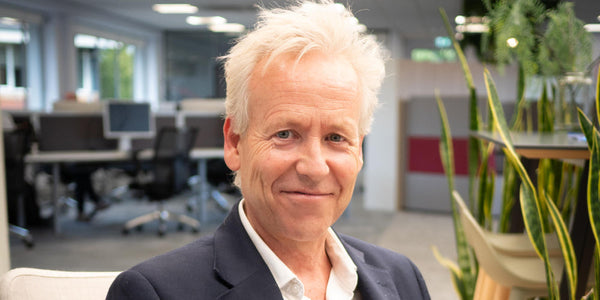


Fleet1000 speaks to MICHELIN Connected Fleet CEO Sophie Foucque on data strategy, EV transition and turning insight into action
"In any fast-paced, rapidly evolving sector that depends on continual innovation, having diverse minds is critical. Mobility cannot be an exception."

French-born and now based in London, Sophie Foucque brings more than two decades of experience across digital transformation, mobility and global business leadership, having worked across Europe, the US and Asia and spent nearly 15 years within the Michelin group.
Her appointment as CEO for Europe, Africa and Australia comes at a time when fleets are under pressure to do more with data, from managing EV transition and controlling cost to improving safety and uptime. Since stepping into the role, she's focused on making that data more usable in practice, including launching an AI Assistant to give fleet managers real-time insight and building out EV transition support and new partnerships across the fleet ecosystem.
In this Fleet1000 conversation, Sophie outlines where fleets are still falling short on data use, why connectivity only works with strong internal processes, and how areas like tyre performance, driver behaviour and AI-led insight are delivering measurable gains across cost, safety and efficiency.
What was the focus of your first year as CEO, and how is that evolving into 2026?
"As mobility becomes increasingly connected, electrified and regulated, our customers face unprecedented transformation needs. In this context, our primary focus remains to provide them unwavering support. We work as a partner to ease decisions from data.
"Beyond the unique human approach, we're innovating through advanced EV transition services, an AI Assistant that provides real-time insights, and new partnerships to enrich their journey. We're joining forces with Schmitz Cargobull, Krone, Euromaster, Telenco, TransPA, Nuonic, and more to design tailored experiences for our fleet customers."

What should fleet managers prioritise now that will matter in three to five years?
"Mobility is evolving very quickly. The first autonomous vehicles are now operating in London, and vehicles are becoming software-defined. Fleet managers should strengthen their technology understanding to fully leverage the most advanced solutions across their key priorities. Focusing on data quality today will be decisive in shifting from reactive to preventive actions, directly improving safety and overall business efficiency.
"The transition to EVs is a new necessity. High-quality data is essential to support this shift, from conducting an initial EV audit, to identifying the most suitable vehicles for transition, to securing the most cost-effective charging options - whether at home, at company sites, or on the road.
"The future also starts with the ability to detect driver distraction through AI-powered dashcams combined with computer vision."
Where are fleets falling short when it comes to using their data effectively?
"Data often sits in silos. Vehicle data, tyres data, camera data - these are looked at separately, when the real value comes from connecting them to understand total fleet performance.
"Beyond mere understanding, fleet managers must be able to translate these insights into concrete actions within their existing business systems (ERP, HR, Transport management) to achieve positive business impact.
"This necessitates viewing operations as an interconnected ecosystem, evolving internal processes, and undergoing a company-wide transformation to fully capitalize on connectivity. Success hinges on clear KPI targets that drive behaviour, as well as maintaining high data quality, which is the top priority and requires dedicated change management effort.
"Effective change management and support are paramount in driving new behaviours during this transition. At MICHELIN Connected Fleet, we offer unique in-person sessions to assist fleet managers in operationalizing mobility data. Choosing a supportive partner is crucial."

Where are fleets seeing the fastest return on investment from connected data today?
"MICHELIN Connected Fleet not only delivers a powerful solution but also offers unparalleled in-person support. This support is crucial for translating data and insights into clear, prioritised actions customised for each fleet's unique situation, and for assisting operators in integrating these actions into their daily operations.
"In practice, the quickest gains are typically found in 3 areas: safety, productivity and lower environmental impact:
- Safety: Driver behaviour solution gives real-time alerts both to drivers and fleet managers of driving behaviour (harsh acceleration, breaking, speeding, idling). Our AI cameras give live feedback of potential hazardous driving situations like fatigue, distraction, or unsafe habits such as eating or drinking while driving. Customers piloting this solution have reported a 40% reduction in accident claim costs of vehicles using cameras and 23% less driving incidents.
- Productivity: Optimized Tyre Performance solution combines smart tyre management, predictive maintenance and real-time monitoring. Results: tyres that last longer, fuel savings of up to 12%, a reduction of 80% tyre related breakdowns.
- Sustainability: Through our decarbonisation solution, we help our customers optimise energy use across their electric vehicles by combining: driver coaching on eco-driving techniques like regenerative braking and reduced highway speeds, with continuous monitoring and data analysis to identify where efficiency can be improved.
"In line with our customer-centric DNA, we're empowering fleet managers with a new AI Assistant, now available on the MyConnectedFleet platform. This innovation allows fleet managers to instantly analyse their fleet data, providing answers to operational questions in seconds and replacing what previously took hours of manual reporting. Fleet managers can quickly and easily rank and group drivers by performance (harsh events, idling, speeding, etc.), measure fuel consumption by driver, group, or vehicle type, and gain insights on journey data, vehicle start/stop activity, and productivity metrics - all with our unconditional commitment to ethical AI."
You've recently introduced Optimised Tyre Performance - what problem is this getting to the heart of?
"Optimised Tyre Performance is designed to solve a very practical problem fleets face every day: tyres are one of the biggest cost and uptime levers, yet they’re also one of the least “visible” assets. Too often, the first signal a fleet gets is a roadside event caused by slow pressure loss, overheating or uneven wear, and that means unplanned downtime, disruption to deliveries, and avoidable cost.
"we help fleets shift from reactive to predictive management. By combining 130 years of vehicle dynamics experience with 30 years of data science expertise, we provide unique services that monitor tyre health, prevent road incidents through early issue detection, maximise vehicle uptime, reduce costs by extending tyre lifespan, minimise premature replacements, and lower maintenance expenses with predictive alerts and expert support. Keeping tyres in peak condition longer also reduces waste, improves fuel efficiency, and lowers the overall environmental footprint.
"This approach enables fleets to schedule replacements before failures occur, reduce downtime, and optimise total cost of ownership. Customers using the solution have avoided up to 80% of tyre-related breakdowns or incidents, reduced vehicle fuel consumption by up to 12%, and increased tyre wear potential by up to 1.3mm."

What does good tyre management actually look like in practice?
"Measurement is key - we can only improve what we measure. I’d recommend leveraging technology. As an example, use predictive tyre monitoring and real-time alerts to detect under-inflation, temperature anomalies, or other emerging issues early. This not only prevents breakdowns and unsafe driving conditions but also enables fuel savings and optimises overall fleet performance."
What have your experiences taught you about leadership and diversity in fleet?
"More than being a woman in a male-dominated industry, what has shaped me across my career is probably more the experience of living abroad. I've lived on three continents: Europe, the US, and Asia. It has definitely pushed me to develop essential leadership skills such as listening, humility and adaptability.
"In any fast-paced, rapidly evolving sector that depends on continual innovation, having diverse minds is critical. Mobility cannot be an exception. Different viewpoints, cultures, expertise, experiences, and ways of thinking boost creativity, help teams question old ideas, and create solutions that work for more people and situations.
I'm convinced that inclusive workplaces that truly value and leverage diverse input create a positive loop of innovation and a stronger edge over competitors. As CEO of MICHELIN Connected Fleet, I'm committed to building a diverse and inclusive organization."